
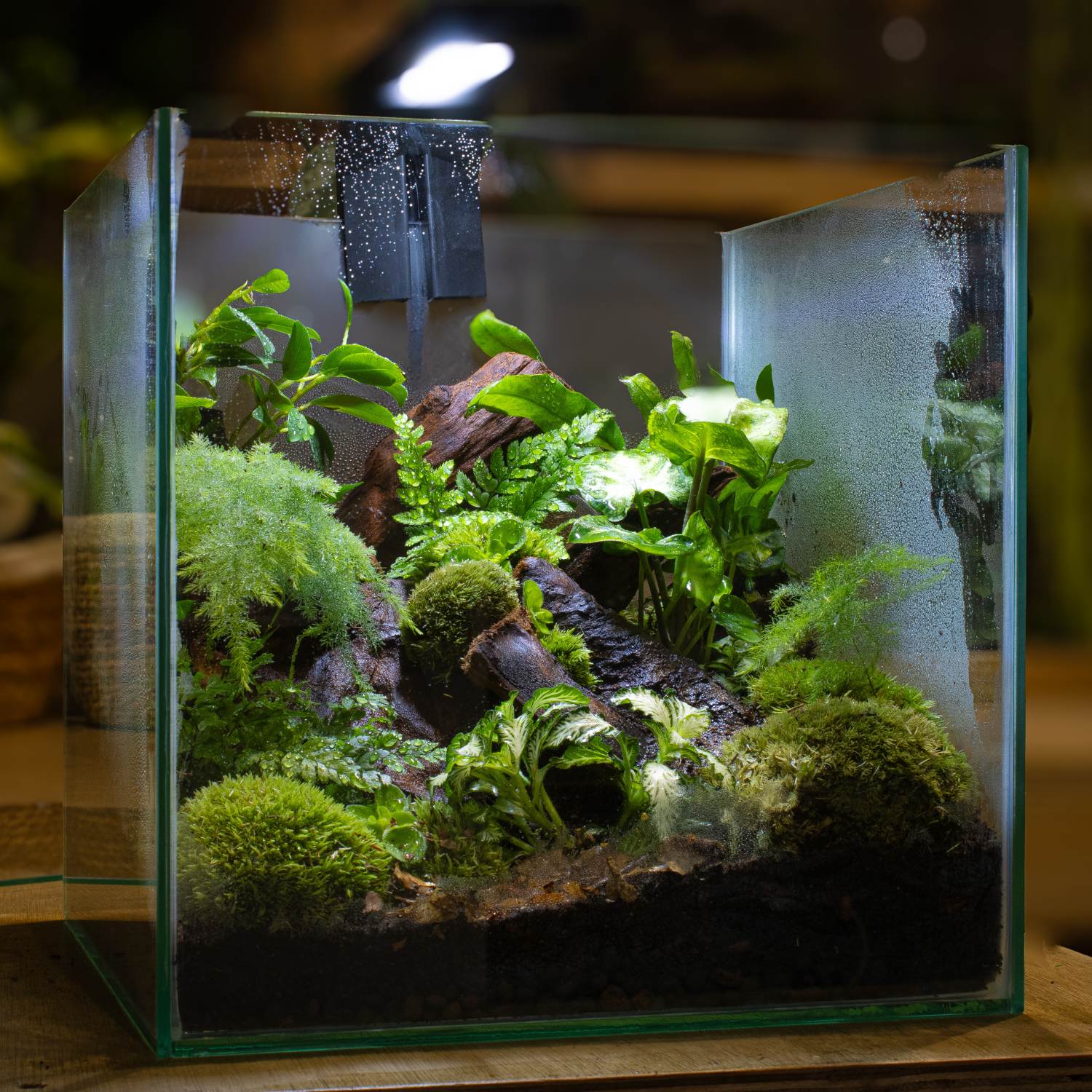
The best plants for closed terrariums are small, humidity-loving species. They thrive in stable, moist environments with low airflow.
Closed terrariums look simple. A glass jar, a few plants, maybe some moss. But anyone who has tried one knows the truth. Some setups stay green for months. Others turn into a soggy mess in weeks.
What actually makes the difference? It comes down to two things:
- The right plants
- The right substrate
Most people focus only on plants. But that is taking the wrong approach. The atmosphere in a closed terrarium is different from a usual pot. It has a moist environment. Due to this, it dries very slowly. Thus, it is crucial that you choose the right plant. The selection of the base layer is also critical. Both should work in harmony.
Why Plant Choice Matters in Closed Terrariums
Closed terrariums trap moisture. Water evaporates, hits the glass, and falls back down. It becomes a mini ecosystem.
That sounds ideal. But it also means:
- No quick drying
- Limited airflow
- Constant humidity
Consider a cactus for a moment. Can it survive in this atmosphere? Definitely not.
So the plants you pick must be adapted to:
- Shade or indirect light
- High humidity
- Consistent moisture
If not, they struggle. Leaves yellow and roots rot. This halts growth.
10 Best Plants for Closed Terrariums
These plants are known to do well in enclosed environments. They stay compact and handle moisture without stress.
1. Nerve Plant (Fittonia)
Best for: Color accent and foreground
Fittonia is often the first plant people try. It is forgiving and very responsive.
- Mature size: 3–6 inches tall
- Light: Low to bright indirect light
- Difficulty: Easy
Why it works:
It loves humidity and stays compact. Leaves may droop if dry, but they bounce back fast after watering. That quick feedback helps beginners learn faster.
Tip:
Place it near the front so the vein patterns stay visible through the glass.
2. Baby Tears (Soleirolia soleirolii)
Best for: Ground cover
This plant spreads like a soft green carpet. It fills empty space quickly.
- Mature size: 1–2 inches tall, spreads wide
- Light: Bright indirect light
- Difficulty: Moderate
Why it works:
It thrives in constant moisture. Closed terrariums provide exactly that.
Tip:
Trim often. If left unchecked, it can cover smaller plants nearby.
3. Moss (Various Types)
Best for: Base layer and moisture balance
Moss almost feels like it belongs in a terrarium by default.
- Mature size: Low growing, usually under 2 inches
- Light: Low to medium indirect light
- Difficulty: Easy
Why it works:
It absorbs and releases moisture slowly. This helps stabilize the environment.
Tip:
Use it around plant bases to reduce soil splash and keep things tidy.
4. Mini Ferns (Button Fern, Lemon Button Fern)
Best for: Texture and mid-height layering
Ferns add softness and movement to the setup.
- Mature size: 6–12 inches depending on type
- Light: Medium to bright indirect light
- Difficulty: Moderate
Why it works:
They love humidity. Closed terrariums mimic forest floors where ferns grow naturally.
Tip:
Avoid placing them too close to the glass. Leaves need space to breathe and expand.
5. Polka Dot Plant (Hypoestes)
Best for: Color contrast
This plant adds bright pink, red, or white speckles.
- Mature size: 6–12 inches if not trimmed
- Light: Bright indirect light
- Difficulty: Moderate
Why it works:
Humidity keeps the colors vibrant. Dry air often dulls the leaves.
Tip:
Pinch back regularly. This keeps the plant bushy and prevents it from getting leggy.
6. Pilea (Pilea depressa, Pilea glauca)
Best for: Trailing layers
Pilea adds a soft, cascading look inside the container.
- Mature size: 2–6 inches tall, trails outward
- Light: Medium to bright indirect light
- Difficulty: Easy to moderate
Why it works:
It adapts well to enclosed environments and grows steadily without getting bulky.
Tip:
Let it trail over rocks or wood pieces. This adds depth and a natural feel.
7. Creeping Fig (Ficus pumila)
Best for: Vertical growth and wall coverage
This plant climbs and spreads across surfaces.
- Mature size: Vines can spread several inches to feet over time
- Light: Bright indirect light
- Difficulty: Moderate
Why it works:
It sticks to glass and hardscape. This creates a layered jungle effect.
Tip:
Guide the vines early. Once attached, they are harder to reposition.
8. Mini Orchids
Best for: Statement plant
Orchids can work in closed terrariums if chosen carefully.
- Mature size: 4–10 inches depending on species
- Light: Bright indirect light
- Difficulty: Moderate to advanced
Why it works:
Small orchid varieties enjoy humidity. But roots still need airflow.
Tip:
Use a breathable medium like high-quality sphagnum moss around roots. Avoid compact soil.
9. Selaginella (Spike Moss)
Best for: Soft greenery and filler
Often mistaken for moss, but it behaves differently.
- Mature size: 4–8 inches tall
- Light: Low to medium indirect light
- Difficulty: Moderate
Why it works:
It thrives in constant moisture. Even short dry spells can stress it.
Tip:
Keep it away from direct light. Too much light can cause drying.
10. Peperomia (Small Varieties)
Best for: Compact structure and leaf variety
Peperomia adds shape without taking over.
- Mature size: 4–8 inches tall
- Light: Medium to bright indirect light
- Difficulty: Easy
Why it works:
It handles humidity well but does not demand constant wet roots.
Tip:
Plant it slightly higher in the substrate. This helps avoid excess moisture at the base.
Quick Comparison Table
| Plant | Role | Size | Light | Difficulty |
| Fittonia | Color accent | Small | Low–Bright indirect | Easy |
| Baby Tears | Ground cover | Very small | Bright indirect | Moderate |
| Moss | Base layer | Very small | Low–Medium | Easy |
| Mini Ferns | Texture/height | Medium | Medium–Bright indirect | Moderate |
| Polka Dot | Color pop | Medium | Bright indirect | Moderate |
| Pilea | Trailing | Small | Medium–Bright indirect | Easy–Moderate |
| Creeping Fig | Vertical | Spreading | Bright indirect | Moderate |
| Mini Orchids | Statement | Small | Bright indirect | Moderate–Hard |
| Selaginella | Filler | Small–Medium | Low–Medium | Moderate |
| Peperomia | Structure | Small | Medium–Bright indirect | Easy |
Plants to Avoid in Closed Terrariums
Some are not suited for terrariums. They slowly decline because the environment does not match their natural needs.
If there is ever doubt, it helps to ask: “Does this plant like to dry out between watering?”
If the answer is yes, it probably does not belong in a closed terrarium.
Common Plants That Do Not Work Well
Here are some plants best left out and why.
- Succulents
Store water in their leaves and need dry soil. Constant moisture leads to rot. - Cacti
Adapted to desert conditions. High humidity causes stress and root problems. - Lavender
A Mediterranean plant that prefers dry air and well-drained soil. It struggles in enclosed moisture. - Rosemary
Needs airflow and drying cycles. Closed environments keep it too wet. - Most culinary herbs (basil, thyme, oregano)
These plants need airflow and regular drying. They do not handle trapped humidity well.
Common Mistake: It’s Not the Plant, It’s the Base
Two people can use the same plants. One terrarium thrives. The other fails. Why? Because of what’s underneath. The substrate controls:
- Moisture retention
- Airflow to roots
- Microbial balance
If this layer holds too much water, roots suffocate. If it dries unevenly, plants stress out.
So before thinking “Which plant should go in?”, the better question is:
“Will the base support these plants long-term?”
The Substrate That Actually Works in Closed Terrariums
Closed terrariums need a base that holds moisture but still lets roots breathe. It’s here that sphagnum moss becomes essential. But not just any moss.
High-quality Spagmoss (New Zealand sphagnum cristatum) is built for this kind of environment. It is widely used in controlled growing systems because it holds water, stays airy, and breaks down slowly.
Why Spagmoss Works So Well in Closed Terrariums
Here is what makes the difference:
- Holds up to 20× its weight in water
- Up to 96% water holding capacity (WHC)
- Releases moisture slowly instead of flooding roots
- Long fibers create natural air pockets
- Helps prevent compaction over time
In short, it gives the plant a stable and breathable environment.
What Makes Spagmoss Different From Regular Moss
New Zealand sphagnum cristatum has a very different structure compared to common alternatives like Chilean moss.
| Feature | Generic Moss | Spagmoss (NZ Sphagnum cristatum) |
| Strand length | Short | Long and strong |
| Water holding | Moderate | Very high (up to 96% WHC) |
| Structure | Breaks down faster | Holds shape longer |
| Cleanliness | Mixed | Cleaned and processed |
| Salt buildup | Possible | Low risk |
Short strands tend to clump. That reduces airflow. Over time, this creates the exact conditions that lead to rot. Long strands behave differently. They stay open and airy, even when wet.
Natural Protection Built Into the Moss
Another detail often missed is what happens at a microbial level. Spagmoss contains tropolene, a naturally occurring compound. It helps reduce the growth of bacteria and fungi.
This does not mean problems cannot happen. But it does mean the system starts cleaner and stays more stable.
That matters in a closed container where airflow is limited.
Classic vs. Premier: Which One Should You Use?
Spagmoss comes in two main grades. Both are processed the same way. The only difference is strand length.
| Grade | Strand Length | Best Use |
| Classic | ~4 inches | Ideal for most terrariums |
| Premier | ~6 inches | Premium option for larger builds |
For most closed terrariums, Classic is more than enough. It is easier to handle and packs well around small roots.
Premier is useful when working with larger containers or when longer strands are preferred.
How to Use It in a Terrarium Setup
Spagmoss can be used in more than one layer. That flexibility makes it very useful.
Where it fits best
- As a barrier layer above drainage
- Mixed lightly into the main substrate
- Wrapped gently around plant roots
How to handle it
- Lightly moisten before use
- Fluff it to keep air pockets
- Do not pack it too tight
How the Full System Comes Together
A stable terrarium is not just one material. It is a layered system. Spagmoss plays a key role in that system:
- It separates layers when used as a barrier
- It stabilizes moisture in the root zone
- It keeps structure intact over time
When paired with proper drainage and a light substrate, it creates a balanced environment. That is what allows plants to settle and grow instead of constantly adjusting.
Pack Sizes That Fit Different Needs
Spagmoss is available in multiple sizes. This makes it easy to match the scale of your setup.
- 150g → expands to ~12L
- 500g → expands to ~40L
- 1kg → expands to ~80L
- 3kg → expands to ~240L
So even a small pack goes a long way for terrarium use.
How to Build a Closed Terrarium (Layer by Layer)
Many setups fail because the layers were rushed or skipped. So its important to get this part right.
Layer 1: Drainage Layer (Base Support)
This is the first layer at the bottom. Its job is simple. It keeps excess water away from the roots.
In a closed terrarium, water has nowhere to escape. So without drainage, the base can turn into a swamp.
What to use:
- LECA (clay balls)
- Small gravel or pebbles
How much:
- About ½ to 1 inch deep
This layer creates a gap where extra water can collect. Roots stay above it, which reduces the risk of rot.
Layer 2: Barrier Layer (Keeps Things Separate)
Next comes a thin barrier. This stops the upper layers from sinking into the drainage layer.
Without this, soil and fine particles move down over time. That blocks airflow and reduces drainage.
What to use:
- Mesh screen
- Or long-fiber sphagnum moss
Sphagnum moss works especially well here. Its long strands interlock and form a natural filter. At the same time, it still allows water to pass through.
This is where high-quality moss makes a difference. Strong, long fibers of such a moss hold shape better and do not collapse into the lower layer.
Layer 3: Activated Charcoal (Optional but Helpful)
This layer is not always required, but it adds an extra level of protection. Closed terrariums can trap odors and impurities. Over time, this can affect plant health.
What charcoal does:
- Filters water
- Reduces odor
- Helps keep the system fresh
How much:
- Around ½ inch layer
If the terrarium is small, even a light sprinkle can help.
Layer 4: Substrate Layer (Where Roots Live)
This is the main growing layer. It supports the plants directly. In closed terrariums, this layer needs to balance two things:
- Hold moisture
- Allow roots to breathe
A mix that stays too wet can suffocate roots. One that dries too fast will not work in a sealed setup. A common approach is:
- A light tropical mix
- Combined with sphagnum moss for moisture balance
Depth guide:
- 2 to 4 inches, depending on container size
This gives roots enough space to spread and anchor properly.
Quick Layer Overview
| Layer | Purpose | Depth |
| Drainage (LECA/gravel) | Prevent waterlogging | ½–1 inch |
| Barrier (mesh/moss) | Stops mixing of layers | Thin layer |
| Charcoal (optional) | Filters impurities | ~½ inch |
| Substrate (soil + moss) | Supports plant growth | 2–4 inches |
What to Watch While Building
Even with the right layers, small mistakes can cause issues later. Keep these in mind:
- Do not overfill water at the start
- Keep layers even and level
- Avoid compressing the substrate too tightly
- Check that water can move through layers
Why This Layer System Works
Each layer has a role. But the real benefit comes from how they work together.
- Drainage layer removes excess water
- Barrier keeps structure intact
- Charcoal keeps the environment clean
- Substrate supports steady growth
When all four are balanced, the system becomes stable. Plants settle in faster and maintenance becomes easier. Most importantly, problems like root rot become far less common.
How to Use Sphagnum Moss in a Closed Terrarium
If sphagnum moss is too loose, it dries unevenly. If it’s too tight, roots suffocate. A balanced approach works best.
Basic method
- Lightly moisten the moss
- Fluff it up by hand
- Place it as a base layer
- Add plants and gently tuck moss around roots
What to aim for
- Moist, not dripping
- Soft, not compressed
- Even coverage
Signs Your Terrarium Is Working (or Not)
Once everything is set up, watch how it behaves.
Good signs
- Light condensation that comes and goes
- Steady plant growth
- Green, firm leaves
Warning signs
- Mushy stems
- Yellowing leaves
- Strong odor
If something feels off, it usually traces back to excess moisture or poor airflow.
How the Right Substrate Supports Long-Term Growth
Plants do not just need water. They need balance. A stable base helps with:
- Consistent moisture cycles
- Reduced root stress
- Cleaner microbial environment
When the substrate holds structure, roots stay active. They absorb nutrients better. Plants respond with steady growth. Over time, that’s what keeps the system alive.
Key Takeaways to Build a Terrarium That Lasts
Before setting up a closed terrarium, keep this in mind:
- Choose plants that naturally like humidity
- Avoid mixing plants with very different needs
- Use a substrate that holds moisture without compacting
- Do not overwater at the start
- Pay attention to early signs
Most failures are not random. They follow a pattern. Once that pattern is understood, things get easier.
Closed terrariums are often seen as decorative. But they behave like living systems. Every small decision shapes the outcome.
So the real question is not just which plants look good together. It is whether the environment being created gives them a reason to keep growing.
FAQs
1. Can you put succulents in a closed terrarium?
Succulents are not a good fit for closed terrariums. They need dry air and fast drainage. A closed setup traps moisture and humidity. This creates the opposite conditions. Over time, the roots stay wet and start to rot. Succulents do much better in open containers with good airflow.
2. How often do you water a closed terrarium?
Closed terrariums need very little watering. In most cases, once every 2–4 weeks is enough. The water cycles inside the jar through condensation. Before adding water, check the glass. If you see constant fog or droplets, wait. Too much water is the most common mistake.
3. Do closed terrariums need activated charcoal?
Activated charcoal is not required, but it helps. It sits below the soil and filters impurities. It can also reduce odors in a sealed space. While plants can survive without it, adding a thin layer gives extra protection. It is especially useful in larger or long-term terrariums.
4. What is the best moss for a closed terrarium?
The best moss holds water but still allows some air to move. Long-fiber sphagnum moss works well for this reason. It stays light and does not compact quickly. It also releases moisture slowly. This helps keep the environment stable, which is important in a closed setup.
5. Why is my closed terrarium turning yellow?
Yellowing usually means stress. The most common cause is too much water. Roots may stay wet for too long. This reduces oxygen and leads to rot. Low light or poor drainage can also cause it. Start by checking moisture levels and airflow before making changes.
6. How long does a closed terrarium last?
A well-built closed terrarium can last for years. Some stay stable for five years or more. The key is balance. Light, moisture, and plant choice all matter. If the system stays clean and not overcrowded, it can run with very little maintenance over time.
7. What size jar is best for a closed terrarium?
Medium-sized jars work best for most setups. Something between 1 to 3 gallons gives enough space for layering and plant growth. Very small jars dry out too fast. Very large ones are harder to manage. A wide opening also helps during planting and maintenance.
8. Is sphagnum moss the same as terrarium moss?
No, they are not the same. Sphagnum moss is a specific type of moss used as a growing medium. It holds water and supports roots. “Terrarium moss” is a general term. It can include sheet moss or decorative moss, which do not behave the same way.